

Last updated on January 21, 2026
How Intelligent Automation Transforms Loan Processing in Fintech – A 2025 Guide
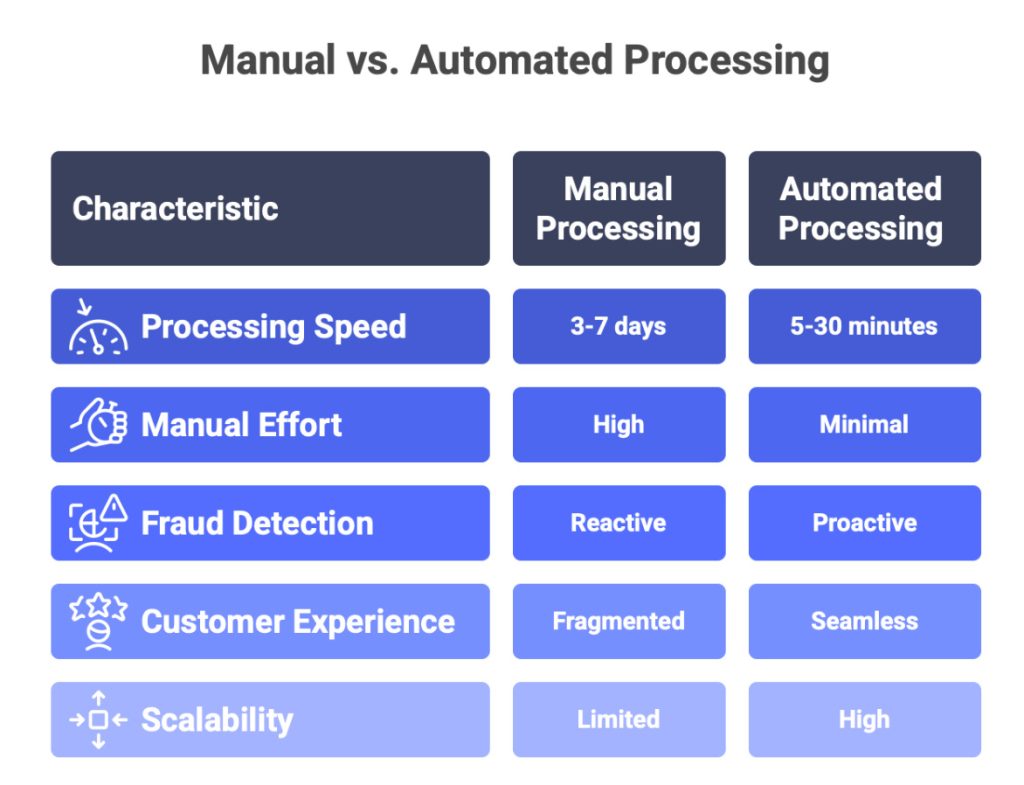
Automation is transforming how loans are evaluated, approved, and managed. Fin-Tech companies leverage software applications to speed up application review, reduce paperwork, and provide quick decisions. What once took days or weeks of manual verification, document review, and approval workflows can now be completed in minutes through intelligent automation.
Intelligent automation that gives intended results has three major facets
- Automation beyond simple document digitalization that truly increases operational efficiency.
- Solutions upgraded to use the latest technologies like AI, NLP, etc. to reduce technical debt , curtail fraud, and future-proof businesses.
- A purpose oriented automation strategy that is more functional and not just technical.
This article evaluates the benefits of advanced end-to-end automation and technology partnerships from the three facts and how they reduce processing times, ensure compliance and a smoother customer journey.
From Manual to Digital: Understanding the Shift
The traditional loan application process required customers to visit physical branches, fill out paper forms, submit physical documents, and wait days for manual verification and approval. Today’s digital loan workflow presents a fundamentally different experience. Customers apply through web or mobile applications, upload documents digitally, receive real-time validation of their information, and get instant or near-instant decisions.
However, the transformation goes deeper than just digitization. Modern systems incorporate intelligent validation, automated verification across multiple data sources, real-time risk assessment, and seamless integration with regulatory compliance frameworks. The result is not merely faster processing but higher accuracy, better fraud detection, and improved security.
Key Components of Automated Loan Processing
1. Automated Identity and KYC Verification
Identity verification forms the foundation of any loan process. Automated systems handle document upload and processing for government-issued IDs like Aadhaar in India or Iraqi National Card in Iraq, or passports. OCR (Optical Character Recognition) technology extracts key information including name, date of birth, and ID numbers from these documents. Biometric verification through face matching compares selfies with ID photos, while liveness checks ensure the person is physically present during verification.
Behind the scenes, AI algorithms verify document authenticity by detecting tampering or forgeries, biometric systems confirm identity, and automated rule engines validate against AML (Anti-Money Laundering) and KYC (Know Your Customer) requirements. The outcome is instant identity verification with significantly reduced fraud and impersonation risks.
2. Income and Financial Data Verification
Traditional income verification required manual review of bank statements and salary slips. Automated systems now handle this through document upload with automatic data extraction or secure API connections to banks with customer consent for direct data access.
The automation layer includes transaction categorization that identifies salary credits, recurring expenses, and other patterns, income consistency analysis that flags irregularities, and EMI obligation detection that calculates existing debt commitments. This eliminates manual statement review while providing faster and more accurate financial assessments.
3. Credit Risk Assessment and Scoring
Risk assessment combines multiple data sources to evaluate creditworthiness. Systems pull credit bureau scores, integrate alternative data such as cash flow patterns and digital behaviour, and apply sophisticated analysis methods.
The automation includes rule engines paired with machine learning models for scoring, fraud pattern detection algorithms, and risk-based pricing logic that adjusts terms based on assessment. This approach delivers more accurate credit decisions and improves financial inclusion for borrowers with limited traditional credit history.
4. Automated Eligibility Decision
Once data is collected and analyzed, decision engines automatically determine outcomes. The system can approve applications that clearly meet criteria, reject those that don’t, or refer edge cases to manual review when needed.
This automation layer incorporates policy rules defined by the lending institution, risk thresholds for different loan products, and compliance checks for regulatory requirements. Decisions that previously took days now complete in minutes with minimal human intervention required.
5. Agreement Generation and Compliance
After approval, automated systems generate loan agreements, execute digital signatures and stamps, and maintain comprehensive audit trails. Document generation engines create customized agreements, while regulatory compliance logging ensures all actions are properly recorded. The result is legally compliant, completely paperless lending.
6. Disbursement and Post-Disbursement Automation
Loan disbursement triggers automated fund transfers to customer bank accounts through API-based payment systems, with automated reconciliation to track transactions. Post-disbursement automation sets up EMI schedules, establishes auto-debit mandates, sends payment reminders, and triggers customer notifications. Workflow orchestration manages the entire process, event-based alerts keep customers informed, and CRM integration maintains engagement throughout the loan lifecycle.
The Role of Human Oversight
Complete automation doesn’t mean eliminating human judgment entirely. Edge cases still route to manual review, including data mismatches between different sources, suspected fraud requiring investigation, and policy exceptions that fall outside normal parameters. This human-in-the-loop approach ensures speed without sacrificing control or judgment.
Technical Foundations
Building effective loan automation requires integration of several key technologies. AI and machine learning power document verification, risk assessment, and fraud detection. OCR and computer vision extract and validate information from documents. API architectures enable real-time data exchange with banks, credit bureaus, and government databases. Cloud infrastructure provides the scalability and reliability needed for high-volume processing. Security frameworks ensure data protection through encryption, tokenization, and secure communication protocols.
Why Automation Matters for FinTech
Automated loan workflows enable FinTech companies to scale lending operations rapidly without proportional increases in staff, reduce both operational costs and fraud losses, maintain regulatory compliance through consistent process execution, and deliver the instant, digital experiences that modern customers expect.
The competitive landscape increasingly favors companies that can offer quick decisions, minimal documentation requirements, transparent processes, and convenient digital access. Automation makes these capabilities economically viable even for smaller loan amounts that would be unprofitable under manual processing.
Looking Forward
As technology continues to evolve, loan automation will incorporate even more sophisticated capabilities. Advanced machine learning models will improve risk assessment accuracy, alternative data sources will expand credit access, blockchain technology may streamline verification and record-keeping, and conversational AI could guide customers through the application process.
The trajectory is clear: lending is moving toward increasingly automated, intelligent systems that balance speed with security, convenience with compliance, and scalability with personalized service.
Partner with Experts in FinTech Automation
Building robust loan processing automation requires deep expertise across AI/ML development, API integration, security implementation, and regulatory compliance. As a software development services company specializing in FinTech solutions, BlancoInfotech helps companies design and implement automated loan workflows that deliver results.
Whether you’re starting your automation journey or looking to enhance existing systems, we can help you assess your current processes, design scalable architecture, implement secure and compliant solutions, and continuously optimize for performance.
Ready to transform your loan processing? Contact us to discuss how we can help accelerate your FinTech innovation.